PostHog – We make dev tools for product engineers
All your developer tools in one place. PostHog gives engineers everything to build, test, measure, and ship successful products faster. Get started free.
What it is
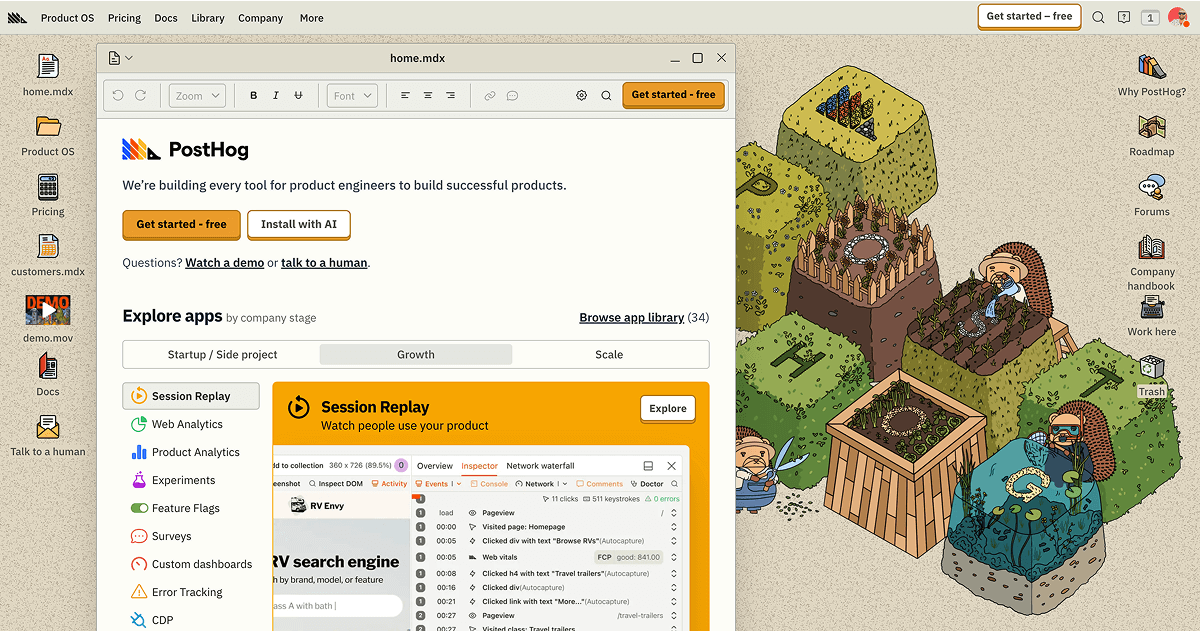
PostHog is an all-in-one product analytics platform designed for developers and product teams. It provides a comprehensive suite of tools to analyze user behavior, test new features, observe product performance, and deploy changes. The platform is built to serve startups, growth-stage companies, and large enterprises, enabling them to build data-driven products without managing a fragmented toolset.
Main Features
PostHog consolidates over ten products into a single, integrated platform.
Product Analytics
- Event-based analytics with auto-capture
- Conversion funnels and cohort analysis
- User paths, stickiness, lifecycle, and retention reports
- Direct SQL access for custom queries
Experimentation and Deployment
- Feature flags for controlled rollouts
- A/B testing (both code-based and no-code)
- Multivariate flag support
User Interaction and Feedback
- Session replay for watching user interactions
- Surveys for collecting direct user feedback
- Product tours for user onboarding
Data Management
- Customer Data Platform (CDP) capabilities
- Data warehouse for integrated analytics
- Embedded analytics for customer-facing dashboards
AI and Automation
- Max AI for automated insights and assistance
- LLM analytics and prompt management
- AI-powered documentation chat
Engineering and Support
- Error tracking for monitoring issues
- API with full access to event and customer data
- SDKs for web, mobile, and server-side environments
How it works
Tracking User Behavior
Users integrate PostHog by installing an SDK (e.g., JavaScript, React, Python) into their application. The SDK automatically captures events like pageviews and user interactions, or developers can manually capture custom events using simple API calls (e.g., posthog.capture('Plan purchased')). This data is sent to the PostHog platform for analysis.
Analyzing Product Performance
Product teams use the PostHog UI to create insights from the captured data. They can build funnels to analyze conversion rates, view trends and graphs, explore user paths, and use SQL to write custom queries for advanced analysis. Session replays allow them to watch real user sessions to identify pain points.
Testing and Deploying Features
Developers use feature flags to deploy new features to specific user segments. They can run A/B tests (Experiments) to compare different versions of a feature and measure their impact on key metrics. Surveys can be deployed to collect qualitative feedback directly within the product.
Key Points
- Open Source and Transparent: The company operates openly, publishing its source code, company strategy, business model, and product roadmap.
- Developer-First: The platform is built for technical users, with a strong API, SDKs for numerous languages and frameworks, and features like SQL access.
- Consolidated Platform: Aims to replace a multi-tool modern data stack by providing numerous integrated products on a single platform.
- Usage-Based Pricing: Employs a pay-per-event pricing model that decreases cost at scale, with a generous free tier (1 million events per month).
- Data Control and Privacy: Offers cookie-less tracking, choice of data hosting region (US or EU), and full access to raw customer data.
Additional Details
- Pricing: The core Product Analytics product has a free tier of 1 million events per month. Paid plans start at $0.00005 per event, with volume discounts available.
- Hosting Options: Available as a managed cloud service hosted in the US (Virginia) or EU (Frankfurt). Also available as a self-hosted open-source option.
- Startup Program: Offers an extended free tier (30M events, 50K recordings), exclusive resources, and guides for pre-product/market fit startups.
- Compliance: Offers SOC 2 compliance, HIPAA compliance, and tools like Data Processing Agreements (DPAs).
- SDK Availability: Supports web (JavaScript, React, Next.js, Vue), server-side (Node.js, Python, Ruby, Java, PHP, .NET), and mobile (iOS, Android, React Native, Flutter) platforms.